
The calendar area of our classroom is used for so much more than just learning the parts of a calendar. It is where students and I say Good Morning to each other and where we discuss the day ahead. Our kindergarten calendar time offers a brief, daily exposure to (and practice with) associated oral language, vocabulary, math, and evaluation skills. As the school year progresses, students exhibit academic and social growth, confidence, and excitement to be leaders.
We celebrate birthdays, review skills, turn and share with partners, count (by ones, fives, and tens), sing songs, and make predictions. But in this post, calendar and weather routines will be my focus. Keep in mind that even though Pre-K students won’t be able to read and lead, this set can be used to begin exposing young children to associated concepts like passing of time, seasons, months, counting, observing and the foundational skills of reading! Use in 1st grade at the beginning of the school year as shown here, but transfer to an entirely student-led activity by mid-year.
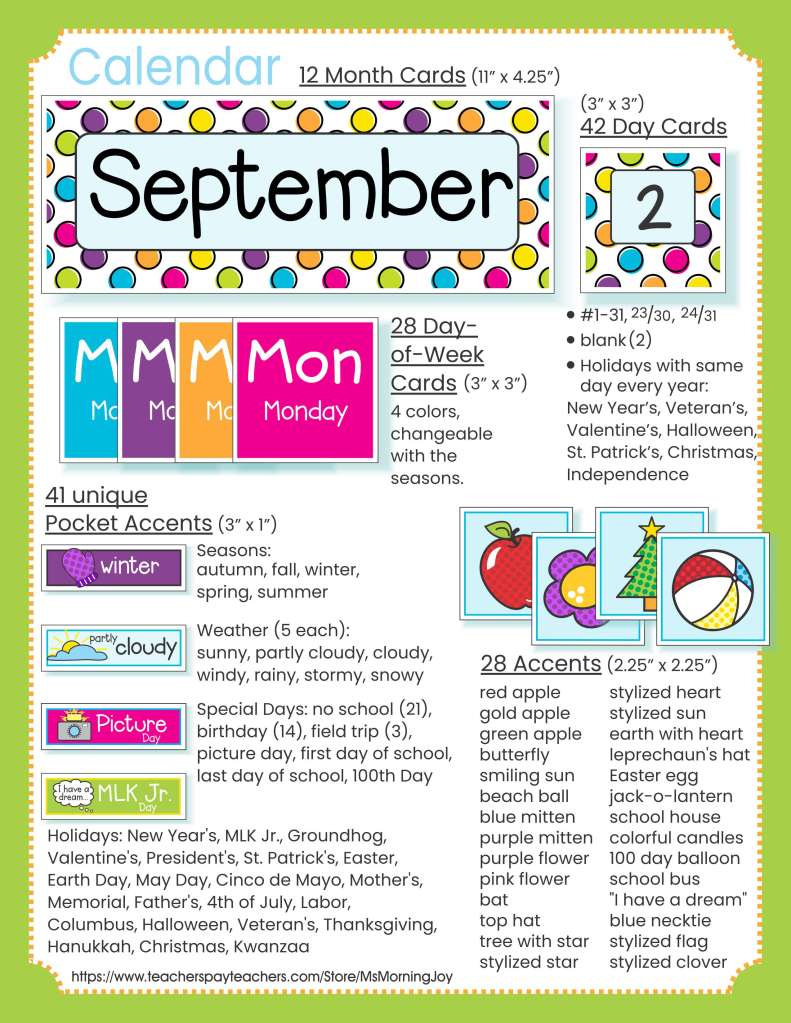
For me, a calendar pocket chart is the best way to display calendar parts because it is easily editable. Most accommodate the 3×3″ Day Cards used here, but double check your dimensions. Day Cards used here can be trimmed a bit, if necessary. I use wide pocket charts (sometimes cut or folded to reveal only the number of pockets I need) for manipulating the Date and Weather Sentence Word Cards and smaller pocket charts to display card options for inserting into the sentences. All of these “holders” are then stapled to my wall.
TIPS for DISPLAYING CALENDAR PARTS
- Display high enough on wall for students in the back to see over heads, but low enough so they can easily assist.
- Place Month Card at top of calendar pocket chart.
- Initially, use different color Day-of-Week Cards for weekends and weekdays. (Four colors are included in the set.)
- Place 3×1″ Pocket Accents in appropriate pockets for the entire month. That way, you’ll be able to see your way ahead.
- Add Day Cards as you go. Remember to count forwards and backwards (the gateway to subtraction).
- Add 2.25″ square seasonal Accents near Month Card, inside blank pockets or use to practice patterning.
TIPS for DISPLAYING DATE SENTENCES (see next image)
- Display Date Sentence Word Cards (DSWCs) below calendar in a wide pocket chart. (Since the words “Today is” will not change, you may want to permanently staple those to the wall.)
- Place Date Sentence Word Cards (as shown) with actual previous day’s date.
- Place remaining day-of-week Date Sentence Word Cards behind the current one.
- Place remaining month Date Sentence Word Cards behind current one.
- Place 3-5 day Date Sentence Word Cards behind current one from which your student will select correct, new day. (Keep all other day number cards nearby.)
- Place only next year’s Date Sentence Word Card behind current year. (Keep all other year cards nearby.)
- Keep a pointer stick nearby for you and students to use.

MY CALENDAR ROUTINE:
Students are seated on the floor around the calendar area and the calendar and Date Sentence Word Cards are set from the previous day. (If a new month, change calendar to reflect correct date and do an edited version of the routine. Continue as usual, the next day.) I also keep a can of “sticks” (with student names) and pull to select helpers. An option is to assigned weekly jobs for Calendar Helper and Meteorologist. Now the stage is set for our calendar routine:
- Point to yesterday’s day card and say, What number was yesterday? Students reply, 15 (for example).
- Choose a student and ask your new Calendar Helper, What number comes after 15?
- Whatever number Calendar Helper offers say, Let’s check ourselves. Good mathematicians always double check. Class counts together from day 1 of the month.
- Follow along with your pointer stick and when you get to today’s pocket, say the number the student gave.
- Ask, Does ____ (provide student’s number) sound correct? Students can quietly show thumbs up or thumbs down.
- If number is correct, affirm that it is! If incorrect, students pair/share ideas for correct number.
- If you were able to hear (during pair/share) that the Calendar Helper might now know the correct number, have him/her volunteer the corrected number. If not, select a student to share who may know. Count again to confirm correctness.
- Entire class counts backward from today’s date to day 1.
- Ask Calendar Helper to change date sentence to match calendar. When completed, give him/her pointer stick.
- Calendar Helper reads alone once, Today is Friday, May 15, 2026. Then says, Please read with me.
- Students repeat date sentence as Calendar Helper leads them with pointer.
- Teacher then mentions anything out of the ordinary happening today and special days coming up!
(Continue reading to view my weather routine which usually follows my calendar routine…)
TIPS for DISPLAYING WEATHER PARTS
- As with the calendar, display high enough for all students to see, but low enough so they can easily assist.
- Begin the year with only the Weather Cards and BASIC Weather Sentence Word Cards. (After mastery, introduce the Temperature Cards and EXTENDED Weather Sentence Word Cards. Then, display Teaching Poster at the top of your board, since kids will not need to access it. Illustrated Temperature Cards and matching Sentence Word Cards should be displayed together. Display very & and word cards as a separate group.)
- Display each illustrated Weather Card next to its matching Weather Sentence Word Card. I just put the word partly next to the partly cloudy illustration and let students know that both partly and cloudy word cards are needed for that illustration when building the sentence. You may choose to introduce a weather set, both illustration and word, each day until all choices are available and familiar, and then begin enlisting student meteorologist helpers.)
- Place the Sentence Word Cards for “Today’s weather is” in the pocket chart with enough room left over for the longest possible sentence. (Since these words will not change, you may want/need to permanently staple them to the wall, and then begin your pocket chart.)
- Perhaps after weather sentences become very familiar, display Weather and/or Temperature Graphs (see next image) to be filled in each day as your students track weather patterns.

MY WEATHER ROUTINE:
- Choose a student as the Meteorologist for the day.
- Ask the Meteorologist to check the weather outside and come back in for his/her report. (For the BASIC sentence, Meteorologist focuses on what it looks like outside. For the EXTENDED sentence, the report will be based on what outside looks like and how it feels.)
- While the Meteorologist is outside, students can pair/share about what they think the weather report will be.
- Meteorologist comes back inside and quickly builds weather sentence. Sing a little jingle: Meteorologist… Can you tell us what the weather is? Then give him/her the pointer stick.
- Meteorologist reads alone once, Today’s weather is partly cloudy. (Turning to “audience”…) Please read with me.
- Student audience repeats weather sentence as Meteorologist leads them with pointer.
- While Meteorologist fills in Weather/Temperature Graph(s) (if displayed), I might ask Do you think we will need our coats for recess today? If students predicted the weather the day before, ask Was our prediction correct?
- To end the routine, all students become meteorologists and predict tomorrow’s weather. Use one of the square Accent Cards to put beside the appropriate Weather Card to mark prediction.
BONUS PRODUCTS INCLUDED
- 2 Sizes of Nameplates (lined and unlined)
- Square Labels (lined and unlined)
- Large Unlined Label
- 2.6″ Gumball Accent Circles
Get all of the above, OVER 340 ITEMS, in my CALENDAR & WEATHER SET.

ALL GUMBALL DESIGN PRODUCTS…
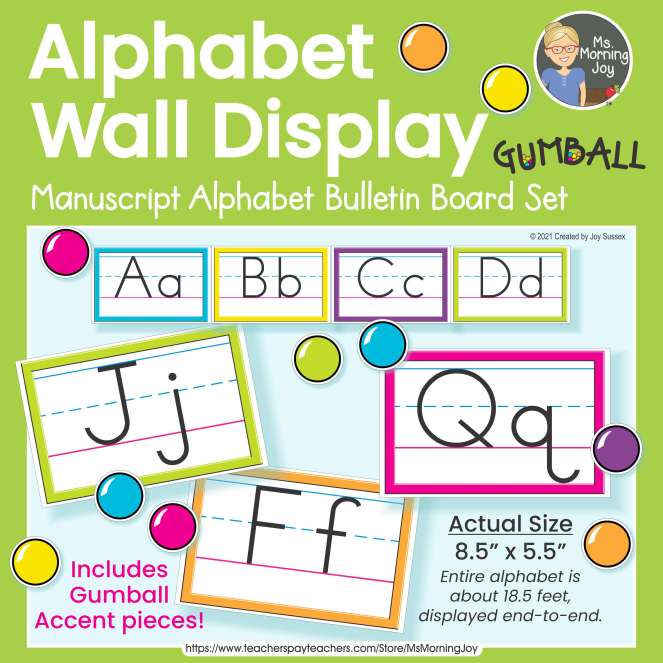
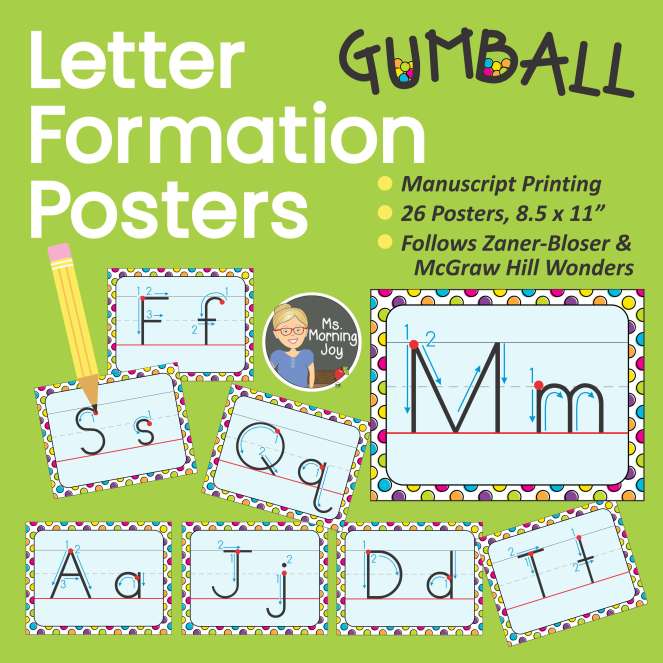
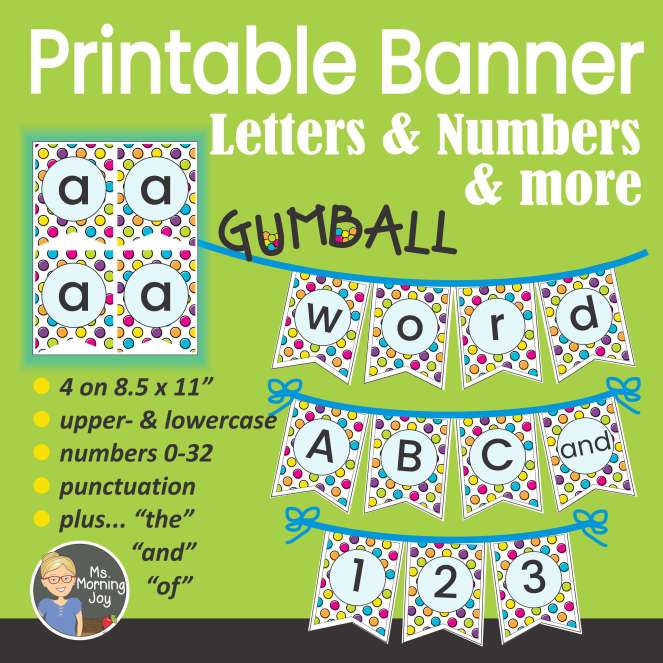
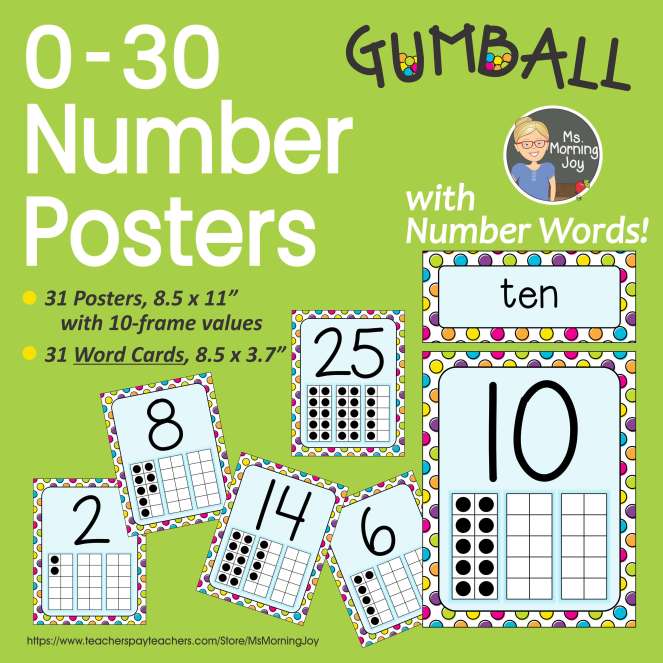
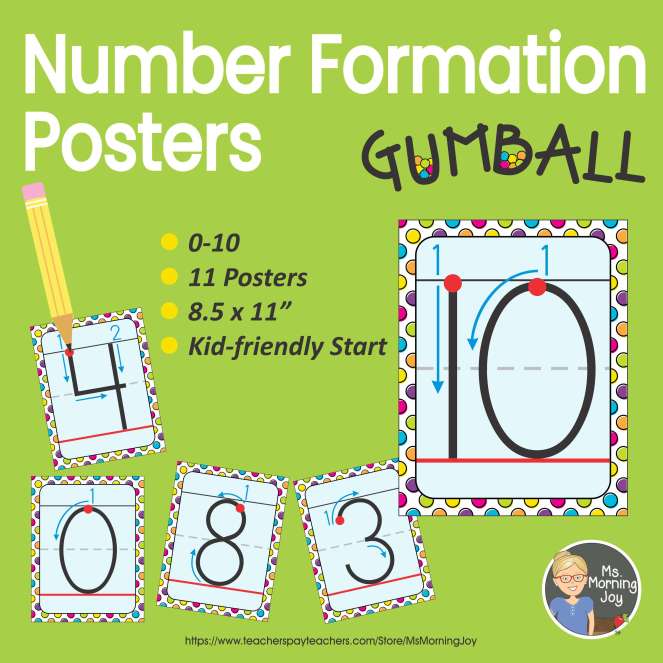

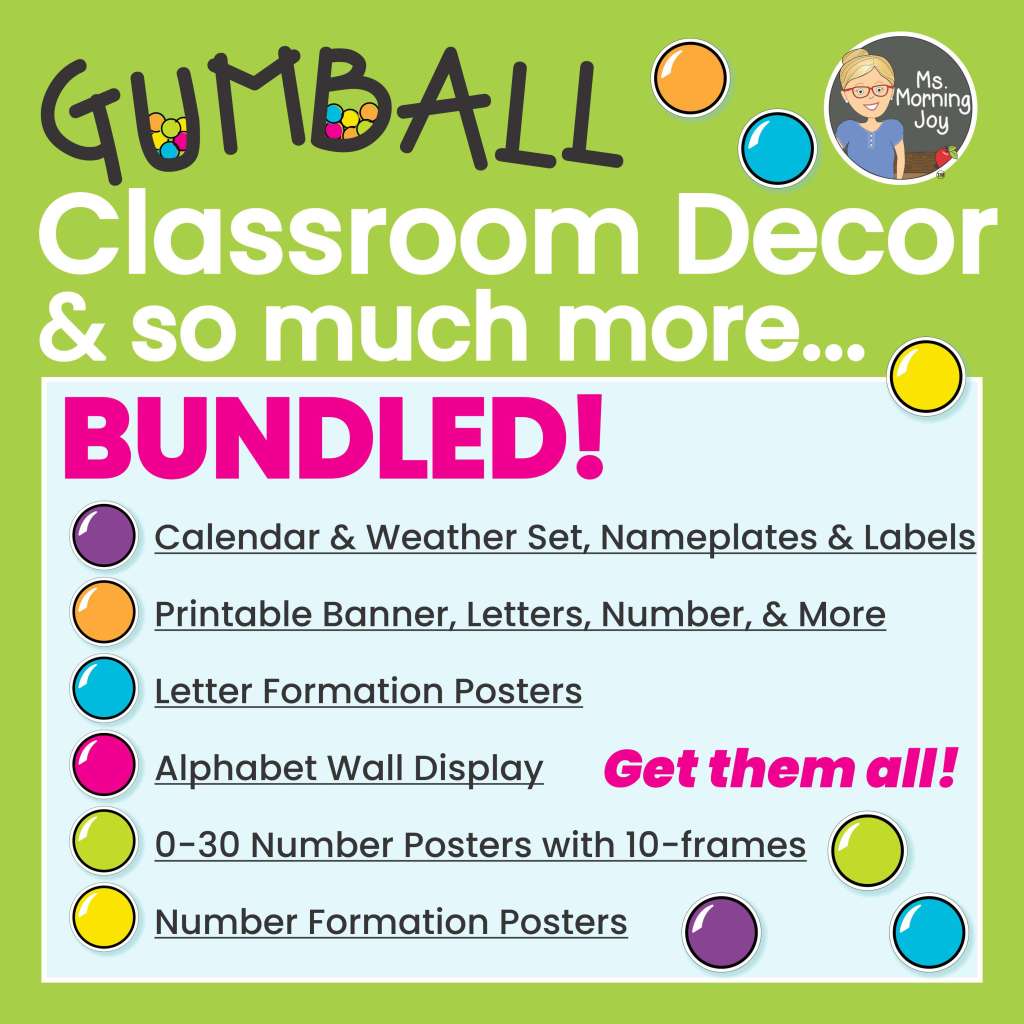
GET THE BUNDLE AND SAVE!
Please email me if you would like to share how you are using these products in your classroom!

 Ms. Morning Joy
Great tool Joy
Get Outlook for iOS ________________________________
Thank you!