
Classroom Life · Teaching Strategies

Phonemic Awareness: Blending (using hand signals)

What is a phoneme? It is the smallest unit of sound heard in a word. For example, the word bat has three phonemes… /b/ /a/ /t/. Phonemes then combine to form spoken syllables and words.

What is phonemic awareness? It is the understanding that spoken words are made up of phonemes (or individual sounds). Because phonemic awareness focuses only on sounds, very young students can practice phonemic awareness before knowing anything about alphabetic letters.

There are many phonemic awareness skills that will help beginning readers. Here are many, listed in ascending order of difficulty.

  • Sound and Word Comparison: What sound is not like the others: /m/ /t/ /m/? /t/
    What word doesn’t belong with the others: “sat”, “mat”, “cat”, “pan”? pan
  • Rhyming: What word rhymes with “mat”? sat (or bat, rat, etc.)
  • Syllable Splitting:
    What is the onset (first sound) and rime (all remaining sounds) of “mat”? /m/ /at/
  • Blending*: What word is made when these sounds are blended, /m/ /a/ /t/? mat
  • Phoneme Segmentation*: What are the sounds in “mat”? /m/ /a/ /t/
  • Phoneme Deletion: What is “mat” without /m/? at
  • Phoneme Manipulation: What word is made when you change /t/ in “mat” to /n/? man

    *Blending and Segmenting are high priority skills.

Why use hand signals? Hand signals help students “see” what is orally being practiced. They identify the signal with the type of skill being taught. I have different signals for segmenting, onset and rime, and rhyming activities (for instance). In this video, students are blending phonemes to make words. There are different hand signaling methods out there, but I like using this method for two reasons: (1) students can correlate the number of phonemes with the number of fingers held up; and (2) I can use the non-signaling hand to stabilize my reference material and keep my place! Students can also learn the hand motions and put them to use when trying to blend sounds as they begin to read. Without good phonemic awareness skills, a student trying to read sun (for example) might be able to say all the individual sounds, but struggles to blend and read the whole word.
Classroom Life · Encouragement

Look for the unexpected.

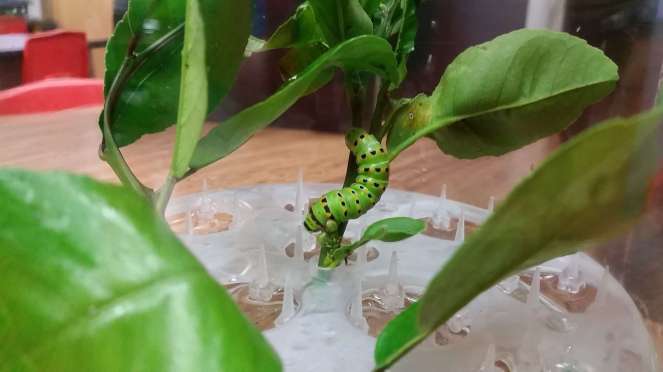
One morning, I found this beautiful, shiny green caterpillar nestled in my little lemon tree. I was headed to work and thought… My students will love to watch this little guy (or girl)! I quickly gathered a clear container, clipped the branch that was now his home, and headed to school (all the while imagining the smiles on my students’ faces).

When I got to school, I placed our new classroom friend on a table surrounded by magnifying glasses and any books or kids’ magazines I could find on caterpillars and butterflies. I also set out scratch paper and drawing materials. As expected, students entered our classroom with smiles of wonder and excitement! One student wondered what kind of butterfly our caterpillar would become. Her question provided me the opportunity to ask the class if we might find that information in fiction or non-fiction text? Students started looking through books to find pictures of our caterpillar. They started sharing their findings and providing opinions to each other. They were asking questions. They were making comparisons, discoveries… They were learning! Even though we were not sure our new friend was the larva of a black swallowtail butterfly, it didn’t matter. In fact, the not knowing became a source of continued wonder for weeks to come.

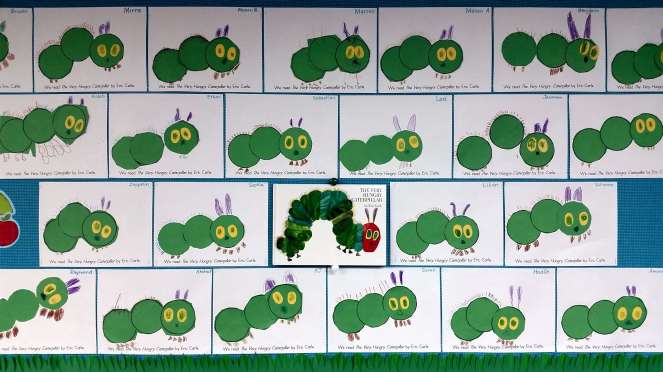
After reading The Very Hungry Caterpillar (by Eric Carle) later in the day, kids made their own paper caterpillars out of green circles, yellow ovals, and crayons. I included the words “We read The Very Hungry Caterpillar by Eric Carle” at the bottom of the background papers. I like to do this when art is connected to something we read in class. That way, parents can ask students questions about the stories we read and perhaps even listen to a retelling or two or three…!

That wonderful, caterpillar day was one of my favorites! Classroom management was easy; In order to spend more time at the “caterpillar table”, students were extra motivated to complete their work. I had not planned to find a cool caterpillar in my yard. Nor did I expect caterpillars to be the topic of the day. I even had to borrow a bit of construction paper for our art project, because I didn’t plan for that either. Even so… It was a joyous day, full of authentic learning.

Not all days will be like this in your classroom. Planning is essential to ensure all students are guided through their learning in a logical process (i.e., learning certain skills before moving on to more difficult challenges). But, if we look for the unexpected and are open to the possible learning outcomes, we can often insert more authentic, hands-on learning for our students — a much more engaging way to learn. We don’t want to be so ridged in “sticking to the plan” that there isn’t space enough to truly answer questions like how?, why?, what if?